
In the digital world, having a website is only half the battle. If your site doesn’t appear on the first page of Google, you’re essentially invisible to thousands of potential customers. This is where Search Engine Optimization (SEO) comes in.
Table of Contents
What is SEO?
SEO stands for Search Engine Optimization. It is the process of improving your website to increase its visibility in “organic” (non-paid) search results.
When people search for products or services related to your business on Google, Bing, or AI-powered search engines, the goal of SEO is to ensure your site appears as high as possible. The higher the ranking, the more likely you are to attract clicks and grow your business.
How Does Search Engines Work?
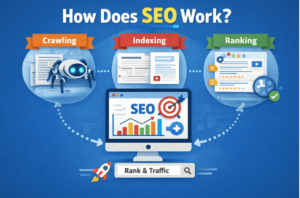
Search engines like Google , Bing, Yahoo and more don’t just “guess” which websites are the best. They use complex algorithms to crawl, index, and rank billions of pages. Here is the simplified version of how it works:
- Crawling
Search engines send out automated bots, known as “spiders” or “crawlers,” to browse the internet. They follow links from one page to another to discover new and updated content.
- Indexing
Once a page is discovered, the search engine tries to understand what it’s about. It stores this information in a giant database called an Index. Think of this as a massive digital library where the search engine files your website under specific categories.
- Ranking
When a user types a query (like “best coffee shops near me”), the search engine scours its index to find the most relevant, high-quality answers. It then ranks these results based on hundreds of factors, including relevance, authority, and user experience.
How SEO Actually Works on Your Website
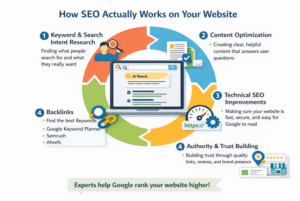
Once you understand crawling, indexing, and ranking, SEO becomes very practical. Here’s what we actively do on a website to help search engines rank it higher:
1️⃣Keyword & Search Intent Research
First, find the right keywords for your product or service.
You should understand:
- What people are searching for
- Whether they want information or want to buy something
For keyword research, you can use tools like:
In 2026, focus more on what the user wants, not just the keyword. Each page should solve one main user need clearly.
2️⃣ Content Optimization
Content tells Google what your page is about.
Best practices:
- Clear H1, H2, H3 structure
- Answer questions directly
- Use simple language
- Add FAQs, lists, and summaries
- Show real experience (examples, case studies, opinions)
Helpful, experience-based content ranks better than generic AI text.
3️⃣ Technical SEO Improvements
Technical SEO helps search engines access and understand your site.
Key actions:
- Improve page speed
- Fix crawl errors (404, redirects)
- Ensure mobile-friendliness
- Secure site with HTTPS
- Add structured data (schema)
4️⃣ Authority & Trust Building
Google ranks websites it trusts.
How trust is built:
- High-quality backlinks
- Brand mentions
- Google Business Profile optimization
- Reviews and ratings
- Consistent content publishing
SEO in 2026: What’s Changed?
SEO is no longer about repeating keywords again and again. Search engines are now much smarter and focus on helping users.
Here are the most important things that matter in 2026:
- User Intent:
Google tries to understand why a person is searching. Some users want information, while others want to buy or book a service. Your content should clearly match what the user is looking for. - AI & Search Results:
Google now uses AI to show quick answers at the top of the page. To appear there, your content should be clear, well-structured, and easy to understand. - E-E-A-T (Experience, Expertise, Authority, Trust):
Google prefers content created by real people who have real knowledge and experience in the topic. - Website Experience:
If your website loads slowly or keeps moving while loading, users leave—and Google notices this. Fast and smooth websites rank better.
As Google Search Advocate John Mueller explains it simply:
“The best SEO strategy is to help users, not search engines.”
— John Mueller
Why Should You Care About SEO?
- Sustainable Traffic: Unlike paid ads, which stop the moment you stop paying, SEO provides a steady stream of traffic for months or even years.
- Builds Trust: Users trust organic results more than “Sponsored” ads. Ranking #1 gives your brand instant credibility.
- High ROI: SEO is one of the most cost-effective marketing strategies because it targets users who are already looking for what you offer.
- Summary
Understanding what is SEO and how it works is the first step toward digital success. By focusing on high-quality content, a fast website, and building authority, you can climb the search results and connect with your audience.
Summary
Understanding what is SEO and how it works is the first step toward digital success. By focusing on high-quality content, a fast website, and building authority, you can climb the search results and connect with your audience.
Frequently Asked Questions (FAQ)
❓ Is SEO still worth it in 2026?
Yes. SEO delivers long-term, compounding traffic and brand trust.
❓ How long does SEO take to work?
Typically 3–6 months, depending on competition and website quality.
❓ Can AI-written content rank?
Yes, if it is useful, original, and edited by humans.
❓ Is SEO better than paid ads?
SEO is long-term; ads are short-term. The best strategy combines both.
❓ Do small businesses really need SEO?
Absolutely. SEO helps small businesses compete locally and sustainably.