
To appear in “near me” searches and AI-generated answers, businesses need three key elements: a fully optimized Google Business Profile, consistent business information across online platforms, and website content that answers questions relevant to their local area.
Google considers relevance, distance, and prominence when ranking local search results. Similarly, AI systems rely on information from multiple online sources to understand and recommend businesses. Having these three elements in place helps improve local visibility and increases the chances of being discovered by potential customers through search engines and AI tools.
Table of Contents
Why “Near Me” Searches Matter for Your Business
When someone types ‘dentist near me’ or ‘best bakery near me,’ they’re usually ready to pick up the phone or walk through the door. They’re not just browsing—they want a service now. That’s why local search signals strong intent, making local SEO such a powerful tool for businesses that serve their community, whether that’s a clinic, shop, bakery, or anything else.
These days, people ask not just Google, but AI assistants too. Questions like, ‘Which is the best digital marketing company near me?’ pop up all the time. The answers come from whatever local business info the AI can find. So, it’s crucial to keep your business details accurate, up-to-date, and easy to find. If you don’t, you’ll miss out on those ready-to-buy customers.
What Is Local SEO?
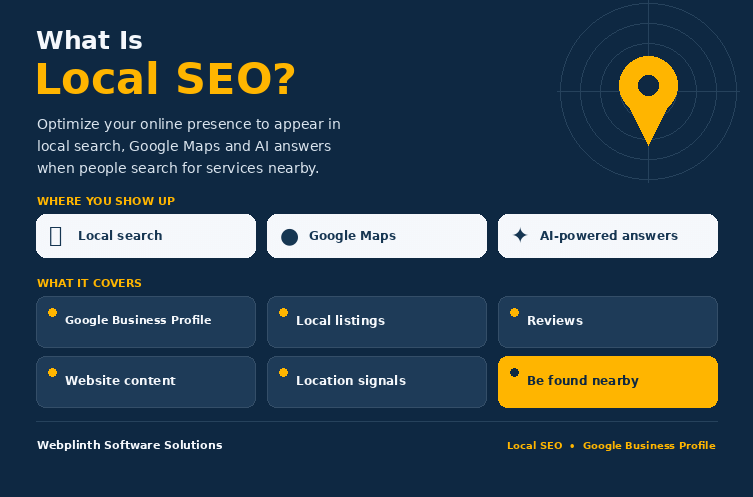
Local SEO is the practice of optimizing your online presence to appear in local search results, Google Maps and AI-powered answers for people searching in your area.
It encompasses your Google Business Profile, local listings, reviews, website content and location-based signals.
What Is a Google Business Profile?
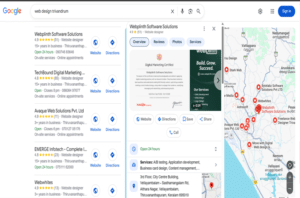
A Google Business Profile (GBP) serves as a complimentary directory entry, showcasing the company’s information including its name, address, phone number, operating hours, images, reviews, and services on Google Search and Google Maps.
It is considered the most valuable local SEO asset for the majority of local businesses.
How Google Ranks Local Results
Google has disclosed that there are three primary attributes, on which local results are determined:
- Relevance: the extent to which the profile satisfies the searcher’s query.
- Distance: how far the establishment is from the searcher or the queried location.
- Prominence: the level of popularity of the establishment measured by the number of reviews, links, mentions, and online footprint.
One can never control the distance variable, but one can significantly influence the other two.
Step-by-Step: How to Optimise Your Google Business Profile
1.Claim and verify your profile
Search for your business on Google and take ownership of your listing. Verify that you’re the owner so you can take control.
2.Select the correct main category
Your main category is a very strong signal of relevance. Select the one that best matches your main service (eg, ‘Website designer’ not something more generic). Use secondary categories sparingly, only where they are relevant.
3.Maintain uniformity in your NAP
Name. Address. Phone number. NAP must be identical to your profile, website, social pages and directories.
4.Write a clear business description
Describe the nature of your work, the kinds of things you do and the geographical areas that you serve, in natural language. Do not try to load your content with keywords. Pretend you are responding to a customer.
5.Add all your services and products
It’s a good idea to include your services and what they cover so users can easily see this. This allows Google to connect you to better, more targeted, searches.
6.Set accurate hours, including holidays
Wrong hours upset customers and undermine confidence. Change special hours for festivals and holidays.
7.Share actual photos and videos
Upload photographs of your storefront, team, work and interiors. Genuine and up-to-date images that customers can relate to increase trust in you.
8.Use Posts and updates
Share offers, news and events often. It proves your business is alive.
9.Enable messaging and include booking or contact links
Encourage people to contact, chat or book directly from your profile.
10.Answer questions and keep the profile fresh
Check your profile and make corrections when there are errors.
Local SEO on Your Website
Your Google Business Profile is most effective when it is supported by your website.
- Develop location + service pages. For instance, “website development in trivandrum” with original, beneficial content.
- Insert your NAP in header and footer, on your contact page.
- Insert a Google Map on your Contact page.
- Local schema markup (Local Business structured data) should be used in a way that search engines know what your specifics are.
- Ensure your site loads quickly and is mobile-friendly. A majority of near me searches take place on phones.
- Include a clear call to action. Call, WhatsApp or book now.
- Provide answers to these local questions with practical examples from your area.
Frequently Asked Questions (FAQ)
1.What’s local SEO, really?
Local SEO gets your business noticed by people nearby when they search for what you offer. It’s all about popping up on Google Maps, in local search results, and on your Google Business Profile.
- Is Google Business Profile actually free?
Yep, it’s totally free to set up and manage.
- How do I show up for “near me” searches?
Start by making sure your Google Business Profile looks great. Keep your info the same everywhere online. Ask for real reviews, and make sure your website has useful local pages. Google looks at relevance, distance, and how well-known your business is.
- How fast does local SEO work?
You can see some small wins in just a few weeks, especially if you update your profile. Climbing higher in rankings, especially where there’s lots of competition, takes a few months of steady work.
- How many reviews do I need to rank?
There isn’t a magic number. What matters is getting real, up-to-date, detailed reviews—and responding to them. Focus on having better reviews than your local competitors.
- Can I rank on Google Maps without a website?
Sure, you can show up with just a Google business profile. But honestly, having a website makes a big difference. It gives your business more credibility, shows off your services, and helps search engines and AI get a clearer picture of who you are.
- What is NAP and why does it matter?
NAP: (Name, Address, Phone). Keeping your NAP consistent across all channels tells search engines (and AI-tools) that they can trust your business. Also good for making sure you don’t get any confusion, either.
- What results do I get in Google AI Overviews and ChatGPT?
Make sure your data matches your business info and generate reviews about your company. Create in-depth responses to the queries asked by the audiences within your speciality; make your info easy to the search engines in order that your data will be appreciated in the results!
- What is the difference between SEO, AEO, and GEO?
With SEO your website appears higher in the search results than your competitors. AEO – answer engine optimization: your answers are linked directly to the search queries. GEO – google engine optimization: your answers are optimized, so that they are accepted by the Google Features. These three fields complement each other, and you will get the maximum benefit from the whole package.
- Should I do local SEO on my own, or should I work with an agency?
Build your local SEO gradually. If you’re starting out, gain some foothold first by claiming your business page and collecting some reviews. For an existing business or a competitive industry, an agency can bring their expertise to bear for you and help you save time in the initial setup of local SEO.